







So, Can You Really Call Your Boss By His First Name?
Social media has found something new to argue about.
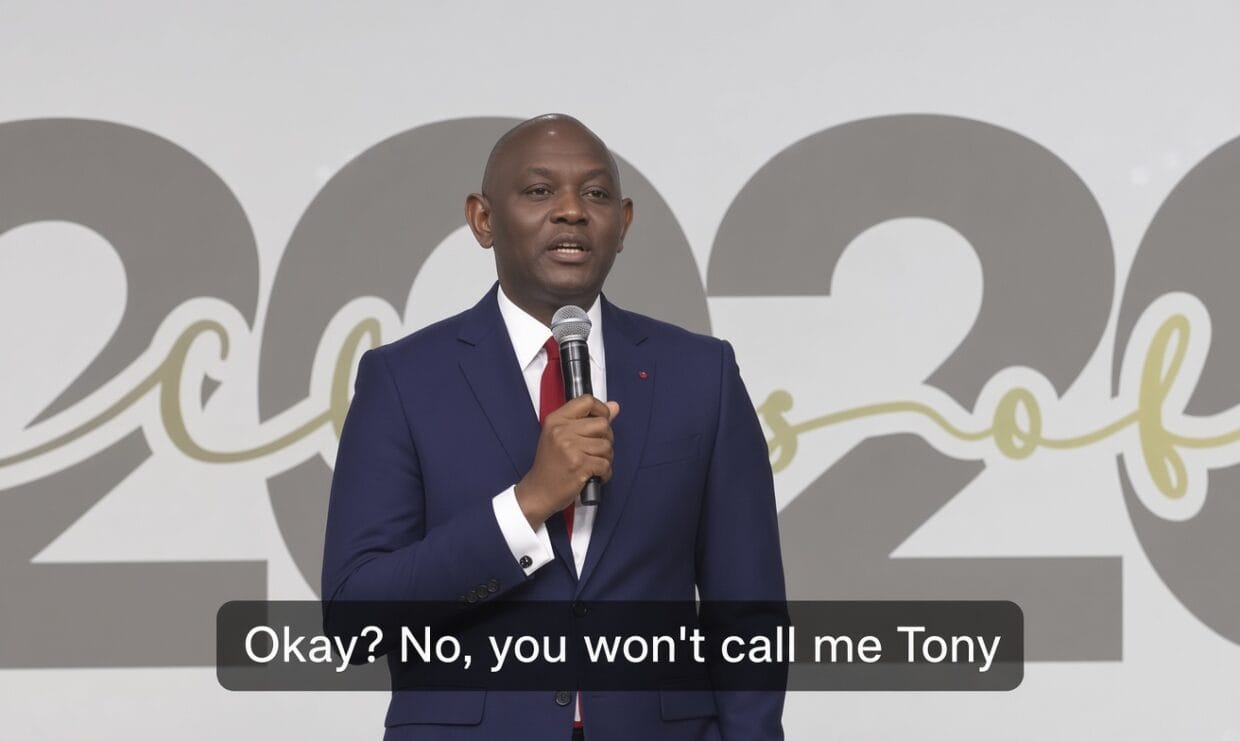
A young woman recently asked Tony Elumelu a question during the UBA Graduate Management Accelerated Programme ceremony, starting with, “Good morning, Tony.”
Before she could continue, Elumelu stopped her.
“No, you won’t call me Tony. You’ll call me Mr. Elumelu or TOE. You won’t call me Tony, or Chairman. I don’t subscribe to that kind of Oyinbo life,” he told her. She quickly corrected herself and continued with her question.
The moment a woman casually addressed billionaire Tony Elumelu as “Tony” while speaking at an event pic.twitter.com/DtAFMAnLau
— Instablog9ja (@instablog9ja) August 20, 2026
And, of course, the internet immediately got to work.
Some people think she was disrespectful. Others think there was absolutely nothing wrong with what she said. One argument is that modern workplaces are becoming less hierarchical, and calling senior executives by their first names can make people feel more comfortable speaking up.
Others believe that when you’re addressing someone older and considerably more senior than you, especially in a formal setting, respect should take precedence over workplace informality.
Honestly, both sides have a point.
There is nothing inherently disrespectful about calling someone by their first name. In many workplaces around the world, it is completely normal. A manager can be “David” instead of “Mr. David,” and a CEO can be “Sarah” instead of “Madam CEO.” The idea is that a person’s position doesn’t have to create unnecessary distance between them and the people they work with.
And that culture can be useful.
A young employee who feels comfortable approaching a senior executive may be more willing to ask questions, challenge ideas, and speak honestly. That’s one reason some modern companies deliberately create less formal environments.
But Nigeria has always had a slightly different relationship with respect.
Here, age matters. Position matters. Context matters. The way you address someone can communicate whether you recognise the difference between you and that person. We grew up with “Sir,” “Ma,” “Oga,” “Madam,” “Uncle,” and “Aunty” being used almost instinctively.
You don’t necessarily use those titles because you are afraid of the person. Sometimes, you use them because that’s simply how you were raised.
And this is where the Elumelu moment becomes interesting.

He wasn’t necessarily saying that nobody should ever call him Tony. He was telling that particular person, in that particular setting, how he preferred to be addressed. That’s a reasonable boundary. If someone tells you, “Please call me Mr. Elumelu,” there isn’t much to debate. You call him Mr. Elumelu.
But the bigger conversation is about what we are becoming as a society.
We are increasingly borrowing workplace culture from other countries without always considering whether every part of it fits our own environment. First-name culture, casual office dressing, calling senior colleagues by their first names, informal communication with executives- these things can work perfectly well.
But being modern doesn’t automatically mean being less respectful.
You can create a relaxed workplace without removing courtesy. You can encourage young people to speak freely without teaching them that hierarchy and respect are outdated. And you can call someone “Mr. Elumelu” without feeling like you’ve just travelled back to 1985.
At the same time, older generations may also have to recognise that younger people are entering workplaces with completely different expectations. Gen Z has grown up in a world where CEOs post on Instagram, executives interact with followers online, and professional and personal identities often exist on the same screen.
The distance between “the boss” and “the employee” doesn’t look the same anymore.
So perhaps the real lesson isn’t whether the young woman was right or whether Elumelu was wrong.
Maybe it is that context matters.
There is a difference between walking into someone’s office, meeting them for the first time at a formal event and saying, “Good morning, Tony,” and being invited by that same person to call them Tony.
There is also a difference between a workplace where first-name culture is deliberately encouraged and a setting where it isn’t.
Respect should not be reduced to titles alone, but neither should titles automatically be dismissed as outdated.
And maybe that’s why this tiny interaction has generated such a big reaction online. It touches something deeper than one woman’s choice of words. It touches the tension between the Nigeria we were raised in and the Nigeria younger people are building.
One side says, “Respect your elders.”
The other says, “We’re colleagues. We’re all human.”
Perhaps we don’t actually have to choose one.
You can make people feel comfortable without making them feel entitled. You can respect someone’s position without treating them as untouchable. You can build modern workplaces without throwing away every cultural value that came before you.
And if someone tells you what they prefer to be called?
Just call them that.
No Twitter war required.